
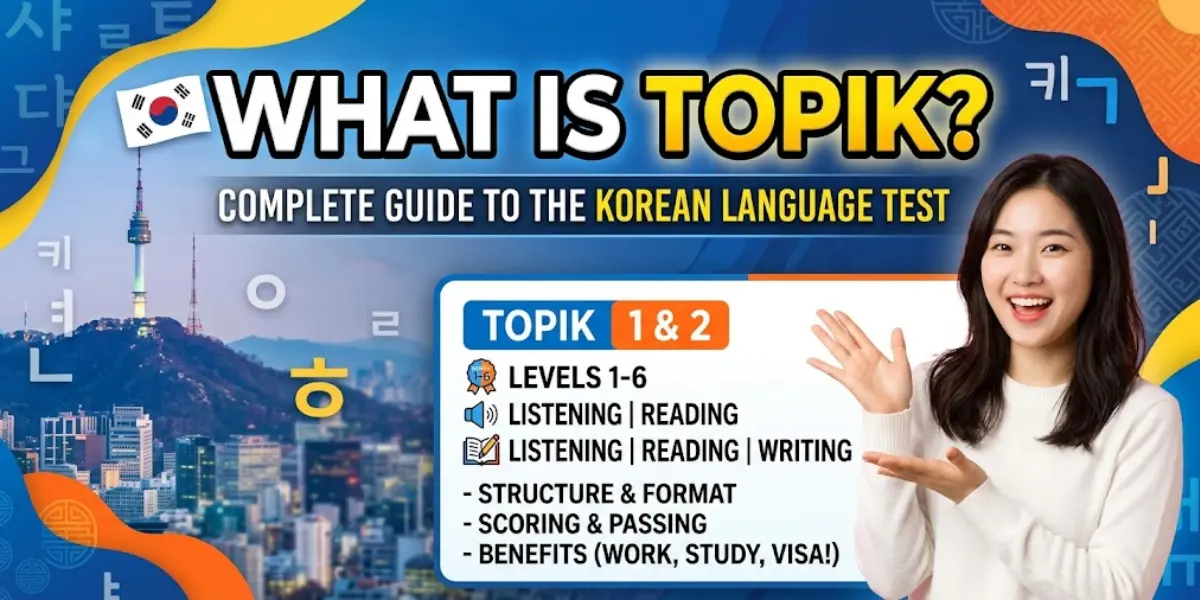
What Is TOPIK?
TOPIK stands for Test of Proficiency in Korean. It is a Korean language test for people whose first language is not Korean.
The test checks how well you can read, listen to and write Korean. TOPIK is useful for people who want to study or work in South Korea.
TOPIK has two main tests:
- TOPIK I – Beginner level
- TOPIK II – Intermediate and Advanced levels
There are six levels in total, from Level 1 to Level 6.
Why Is the TOPIK Test Important?
TOPIK is used to measure a person’s Korean language skills. The test can be useful for:
- Studying at a university in South Korea
- Applying for some jobs in Korea
- Showing your Korean language ability
- Improving your Korean learning goals
- Meeting language requirements for certain programs
A TOPIK certificate can also help students and job seekers show their Korean language level to universities and organizations.
Who Can Take the TOPIK Test?
TOPIK is mainly for foreigners and overseas Koreans who are learning Korean.
You may take the test if you:
- Want to learn Korean
- Plan to study at a Korean university
- Want to work for a Korean company
- Need to show your Korean language level
- Live outside Korea and are learning Korean
- Are studying Korean by yourself or at an institute
There is no special educational requirement for taking the test. You can prepare through a language institute or by self-study.
Who Conducts the TOPIK Test?
The National Institute for International Education (NIIED) manages the TOPIK test.
NIIED works under the Ministry of Education of South Korea. It manages the overall test system and works with institutions that conduct TOPIK in Korea and other countries.
Who Should Take TOPIK?
TOPIK can be useful for different types of Korean language learners.
It is commonly taken by:
- Students who want to study in Korea
- People learning Korean as a foreign language
- International students
- People planning to work in Korea
- People applying to Korean universities
- People who want an official Korean language certificate
The test can also help you understand which areas of Korean you need to improve.
TOPIK Test Levels
TOPIK has six levels.
| TOPIK Level | Korean Level |
|---|---|
| Level 1 | Beginner |
| Level 2 | Beginner |
| Level 3 | Intermediate |
| Level 4 | Intermediate |
| Level 5 | Advanced |
| Level 6 | Advanced |
Levels 1 and 2 are part of TOPIK I.
Levels 3 to 6 are part of TOPIK II.
TOPIK I
TOPIK I is the beginner-level test.
It has two sections:
- Listening
- Reading
TOPIK I covers Level 1 and Level 2.
The test has 200 total marks.
TOPIK II
TOPIK II is for intermediate and advanced Korean learners.
It has three sections:
- Listening
- Reading
- Writing
TOPIK II covers Levels 3, 4, 5 and 6.
The test has 300 total marks.
TOPIK Levels Explained
Level 1 – Basic Korean
At Level 1 you can understand and use simple Korean for everyday situations.
You should be able to:
- Introduce yourself
- Say simple greetings
- Buy basic items
- Order food
- Ask simple questions
- Understand basic everyday expressions
A basic vocabulary of around 800 words is generally expected.
Level 2 – Upper Beginner
At Level 2 you can communicate in more everyday situations.
You should be able to:
- Talk about familiar topics
- Understand simple conversations
- Use around 1,500 to 2,000 words
- Understand the difference between formal and informal Korean
Level 3 – Intermediate
At Level 3 you can handle many common situations in Korean.
You should be able to:
- Communicate in public places
- Maintain basic social relationships
- Understand common Korean expressions
- Use basic Korean grammar correctly
Level 4 – Upper Intermediate
At Level 4 you can understand more difficult Korean content.
You should be able to understand:
- News articles
- Social issues
- General discussions
- Some abstract topics
- Korean cultural content
You should also be able to communicate with better accuracy and fluency.
Level 5 – Advanced
Level 5 shows a high level of Korean ability.
You should be able to use Korean for:
- Professional work
- Academic research
- Discussions about politics and economics
- More difficult subjects
You should also know how to use formal and informal Korean depending on the situation.
Level 6 – Highest Level
Level 6 is the highest TOPIK level.
A Level 6 learner can use Korean very well for professional and academic purposes.
You should be able to:
- Understand difficult Korean content
- Express your ideas clearly
- Communicate without major problems
- Use Korean in professional situations
However, Level 6 does not mean that your Korean is exactly the same as a native speaker’s Korean.
TOPIK Test Structure
The structure of TOPIK depends on which test you take.
TOPIK I
| Section | Questions | Time |
|---|---|---|
| Listening | 30 | 40 minutes |
| Reading | 40 | 60 minutes |
| Total | 70 | 100 minutes |
TOPIK I has 70 multiple-choice questions and a total of 200 marks.
TOPIK II
| Section | Questions | Time |
|---|---|---|
| Listening | 50 | 60 minutes |
| Writing | 4 | 50 minutes |
| Reading | 50 | 70 minutes |
| Total | 104 | 180 minutes |
TOPIK II has 300 total marks.
The test is divided into two sessions with a short break between them.
What Is Included in the TOPIK II Writing Section?
The writing section has four questions.
The first two are short-answer questions. You need to write the answer yourself instead of selecting an option.
The other two questions are essays.
One essay is based on an everyday topic. The other asks you to explain your opinion about a particular subject.
The longer essay requires you to organize your ideas and write a clear response in Korean.
When Is the TOPIK Test Held?
TOPIK is normally held several times each year.
The exact test dates can change each year. Test dates can also be different depending on whether you take the test in Korea or another country.
In many locations:
- TOPIK I is held in the morning
- TOPIK II is held later in the day
You should always check the latest schedule before planning your test.
How Can I Register for TOPIK?
Registering in South Korea
If you are in South Korea, TOPIK registration is available through the official TOPIK website.
The registration process and fees can change, so check the latest information before applying.
Registering Outside South Korea
In other countries, TOPIK is usually organized through:
- Korean Embassies
- Korean Cultural Centers
- Approved test centers
- Other affiliated institutions
Registration rules and fees can be different from one country to another.
You should contact the official test center in your country for the latest registration information.
Is There a TOPIK Eligibility Requirement?
There is generally no special eligibility requirement to take TOPIK.
Anyone learning Korean can take the test.
You can prepare for TOPIK through:
- Self-study
- Korean language classes
- Online courses
- Practice tests
- TOPIK textbooks
How Long Is the TOPIK Certificate Valid?
A TOPIK score or certificate is generally valid for two years from the date the results are announced.
If you need TOPIK for university admission, employment or another application, always check the organization’s current requirements.
How Are TOPIK Results Announced?
TOPIK results are announced through the official TOPIK website.
Your score report normally includes information such as:
- Your TOPIK level
- Section scores
- Total score
- Average score
- Pass or fail result
You may need your test number, application number and date of birth to check your result online.
Can I Print My TOPIK Score Report?
Yes. A TOPIK score report can be printed online when the printing service is available.
This can be useful when you need to submit your Korean language result to a:
- University
- Company
- Government organization
- Other institution
Can I Practice TOPIK Before the Exam?
Yes. Practicing previous TOPIK questions is one of the best ways to understand the test format.
You can practice:
- Listening questions
- Reading questions
- Writing questions
- Vocabulary
- Grammar
- Full mock tests
Previous papers can also help you understand the type of questions that appear in the exam.
TOPIK Preparation Tips
If you are preparing for TOPIK, start with the level that matches your current Korean ability.
Here are some simple tips:
- Learn Korean vocabulary every day.
- Practice Korean grammar regularly.
- Listen to Korean audio and conversations.
- Read Korean sentences and short articles.
- Practice writing in Korean.
- Solve previous TOPIK questions.
- Take full mock tests before the exam.
- Check your mistakes and work on weak areas.
- Practice with a timer.
- Focus more on the sections where you lose marks.
Frequently Asked Questions About TOPIK
What does TOPIK stand for?
TOPIK stands for Test of Proficiency in Korean.
How many TOPIK levels are there?
There are six levels, from Level 1 to Level 6.
What is the difference between TOPIK I and TOPIK II?
TOPIK I covers Levels 1 and 2 and tests listening and reading.
TOPIK II covers Levels 3 to 6 and tests listening, reading and writing.
Is TOPIK difficult?
The difficulty depends on your Korean language level and preparation.
TOPIK I is designed for beginners. TOPIK II is more difficult because it covers intermediate and advanced Korean.
Can beginners take TOPIK?
Yes. Beginners can take TOPIK I, which covers Levels 1 and 2.
Can I take TOPIK without joining a Korean language course?
Yes. You can prepare for TOPIK through self-study.
Is TOPIK useful for studying in Korea?
Yes. Many Korean universities and programs use Korean language qualifications when evaluating international students. However, the required TOPIK level depends on the university and program.
Is TOPIK useful for jobs?
A TOPIK certificate can help show your Korean language ability. Some jobs or organizations may have their own Korean language requirements.
Where can I find the latest TOPIK information?
For the latest test dates, registration details and official announcements, check the official TOPIK website.
Final Thoughts
TOPIK is an important Korean language test for people who want to study, work or build their future in South Korea.
The test has six levels. TOPIK I is for beginners while TOPIK II is for intermediate and advanced learners.
If you are planning to take TOPIK, start by understanding the test format. Then build your vocabulary and grammar and practice listening, reading and writing regularly.
With consistent practice, you can improve your Korean skills and prepare for the TOPIK level you want to achieve.